
Duncan Poulton presents a solo screening of Extreme Present at Shoreditch Arts Club, comprising digital collage and archival works titledWaste, Cave Dream and If you're watching this now then this is for you.
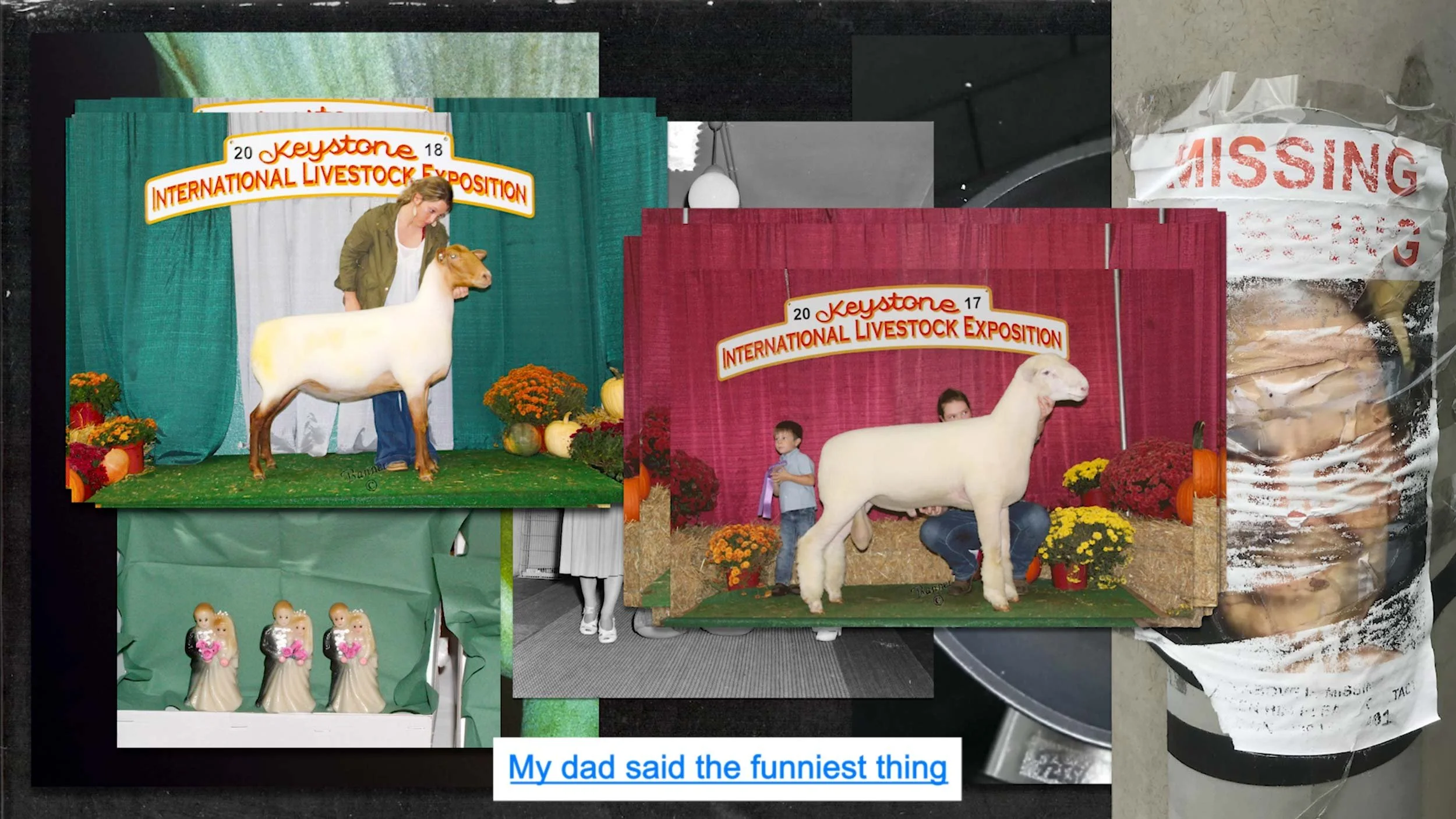
Still from Duncan Poulton’s If you're watching this now then this is for you (2022)
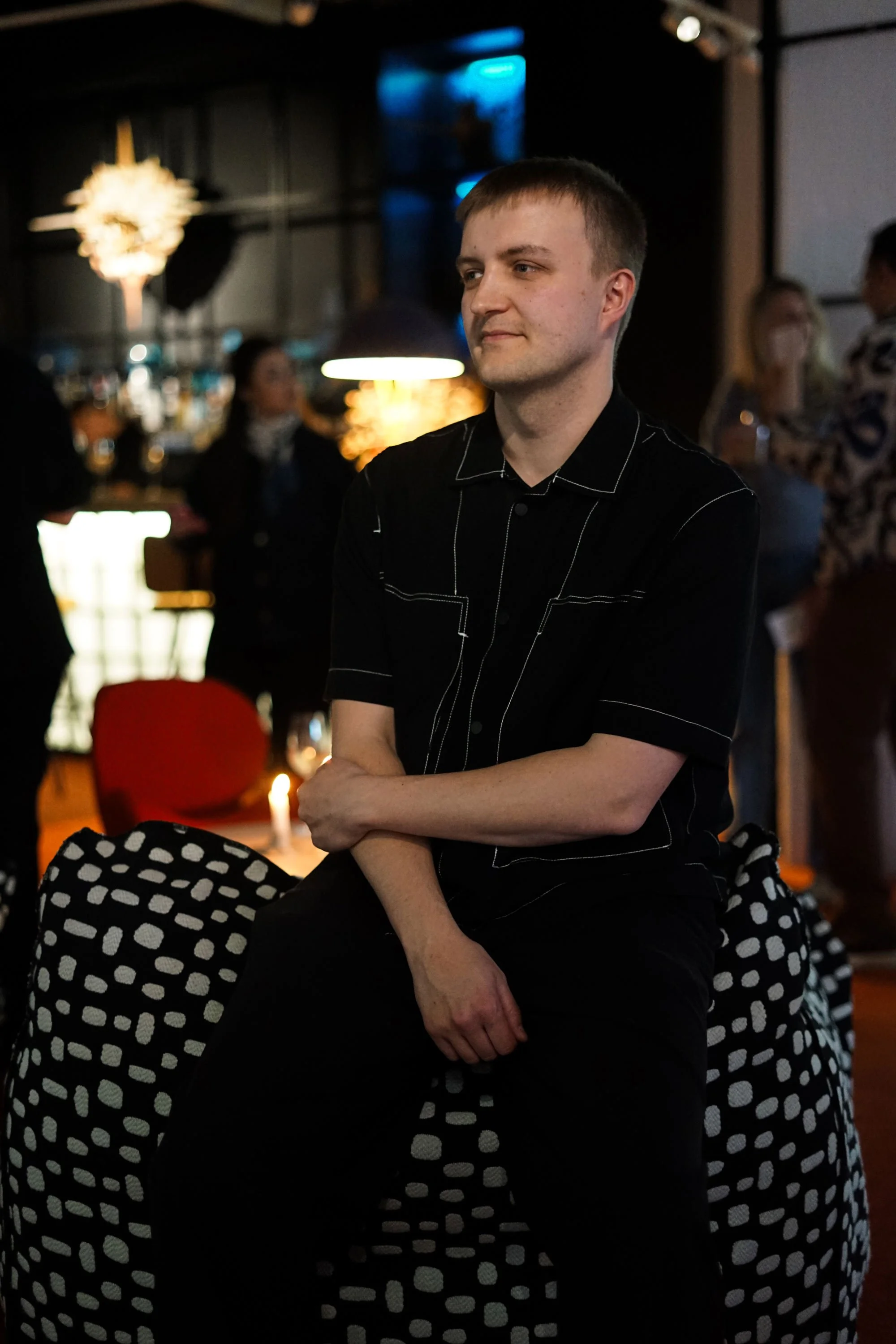
Duncan Poulton is an artist making video, print and installation using found materials. His practice is fed by an obsessive gathering of online content into a vast digital archive, which he recombines into still and moving image collages. Born out of remix, DIY and British folk art approaches, his digital works aim to provoke the same disorientating, intense experience the web creates in us every day. He makes work instinctively, in the gap between the unconscious and conscious, between the algorithm and his flawed human brain. He is a hoarder, selector and combiner, who uses the internet as his palette and imagination.
“My practice reacts to the exuberant excess and associative density of networked living. Individual works emerge instinctively as expressions of feeling and sensation, rather than trying to simplify, narrativize or resolve. A fundamental aspect of my practice to date is a continued interest in and harvesting of ‘digital waste’ – the single-use function, overproduction of, and algorithmic burial of the majority of pictorial content uploaded today.”
Poulton’s works first appeared on the screens at Shoreditch Arts Club to accompany the philosophy edit on April 17, 2026, an evening blending art and contemplative discussion co-curated by perediza and Frieze Connect. Across the Club, a collection of short videos combining digital and analogue techniques evoke feelings of nostalgia, intervention and confrontation. Shoreditch Arts Club spoke to Poulton to discuss this body of work, and dive deeper into what stories Extreme Present are telling.
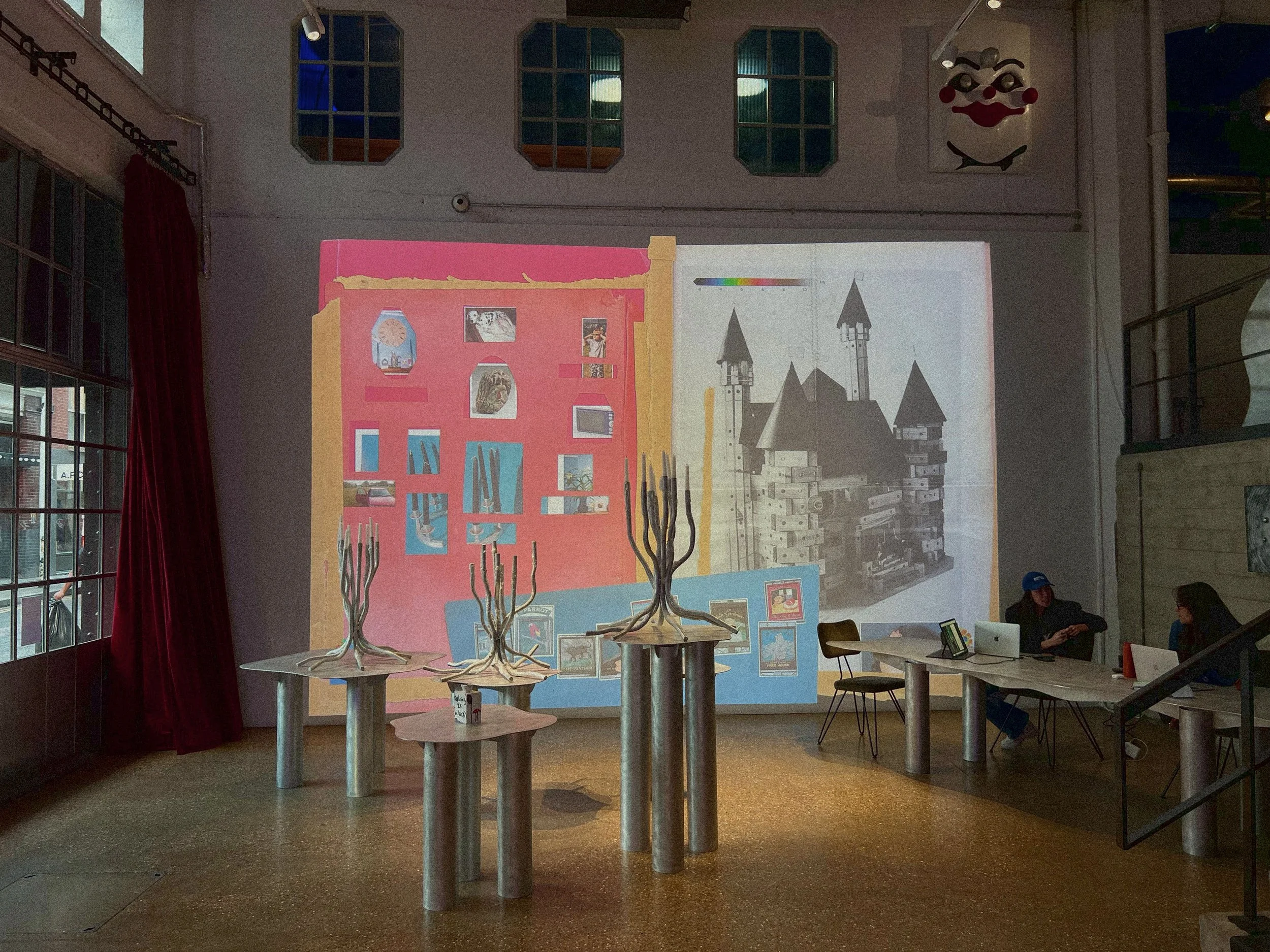
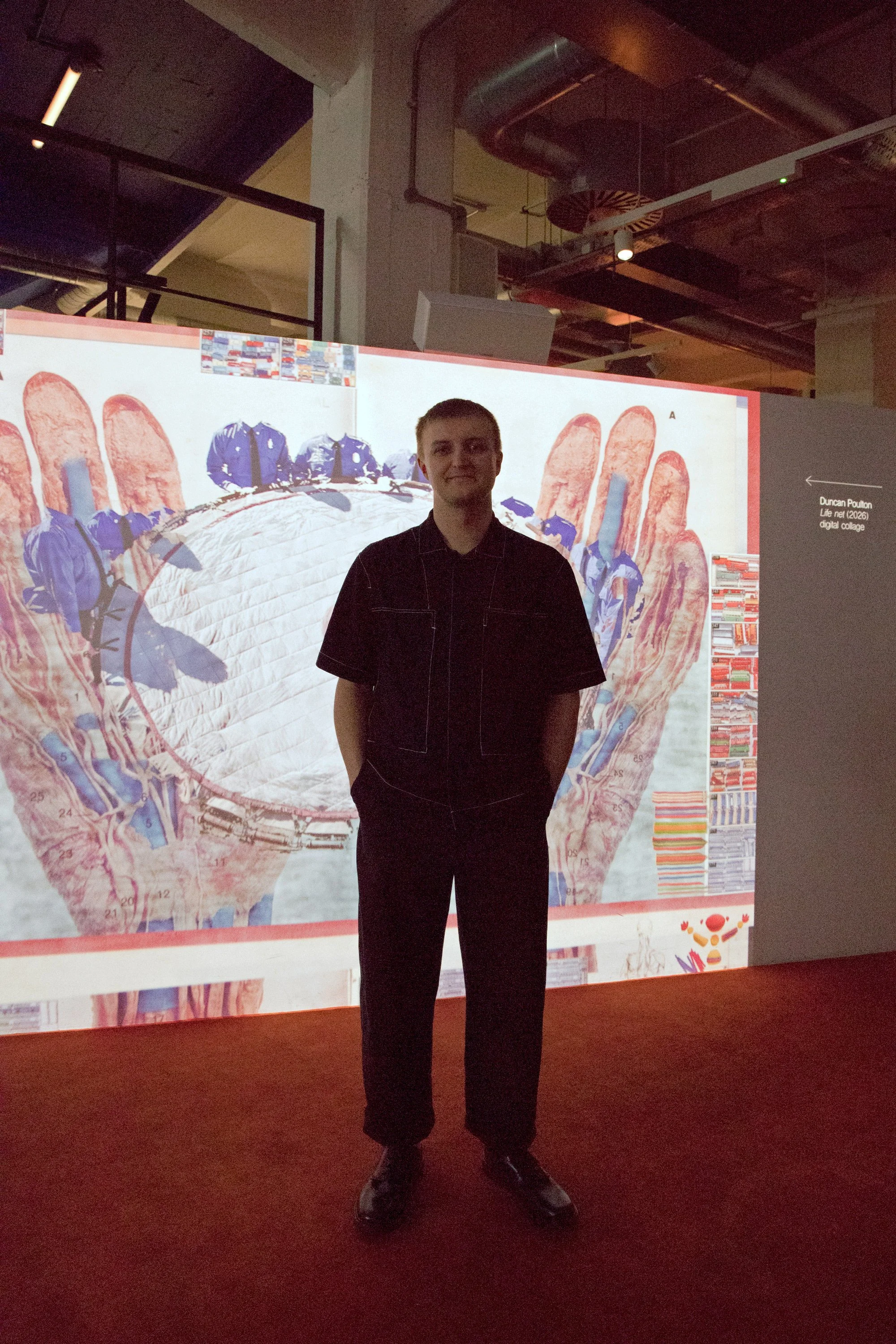
Duncan Poulton: Extreme Present install view at Shoreditch Arts Club, London, 2026
SAC: The title of the exhibition, Extreme Present, feels like an ode to the modern context which surrounds society: shortening attention span, heavy reliance and easy access to short-form, fleeting content that goes against its intense, defining content; a lack of being present in real life, the coined ‘touch grass’ slang. Can you tell us more about the title and the curation of works you are showing across the screens at Shoreditch Arts Club?
DP: Extreme Present brings together a number of projected video works and digital collages. The title is lifted from the great writer Douglas Coupland, and to me speaks to the contradiction of modern life in which we know all that is happening in others’ lives and yet cannot be truly ‘present’ with them. It is all about coexistence of conflicting ideas and that niggling ambient feeling that you must be in two places at once – living in constant simultaneity, never truly on or off. Dualities reoccur throughout the show, namely the body and the device; the sinister and the innocent; the fragile mind and the violent online world.
As you walk into Shoreditch Arts Club, you’re confronted by a giant projection of digital collages, ranging from earlier works like e-Hoarder (Xerox) from 2019, through to very recent works Life Net and The Kiss. They share a rawness in how they are brought to life, in a speedy, rough-and-ready kind of digital production. There are recurring medical and bodily images (fleshless anatomical hands, enflamed eyes, gums, medical apparatus etc.) which speak to my recurring interest in the flatness and detachment of screen-based life, versus the pain and decay of the physical body.
The main space displays three short video works: Waste (2025), Cave Dream (2025) and If you’re watching this now then this is for you (2022). I approach still and moving image largely in the same way; a dense pile of disparate imagery is thrown in, then scrubbed and scratched away at to reveal the final work.
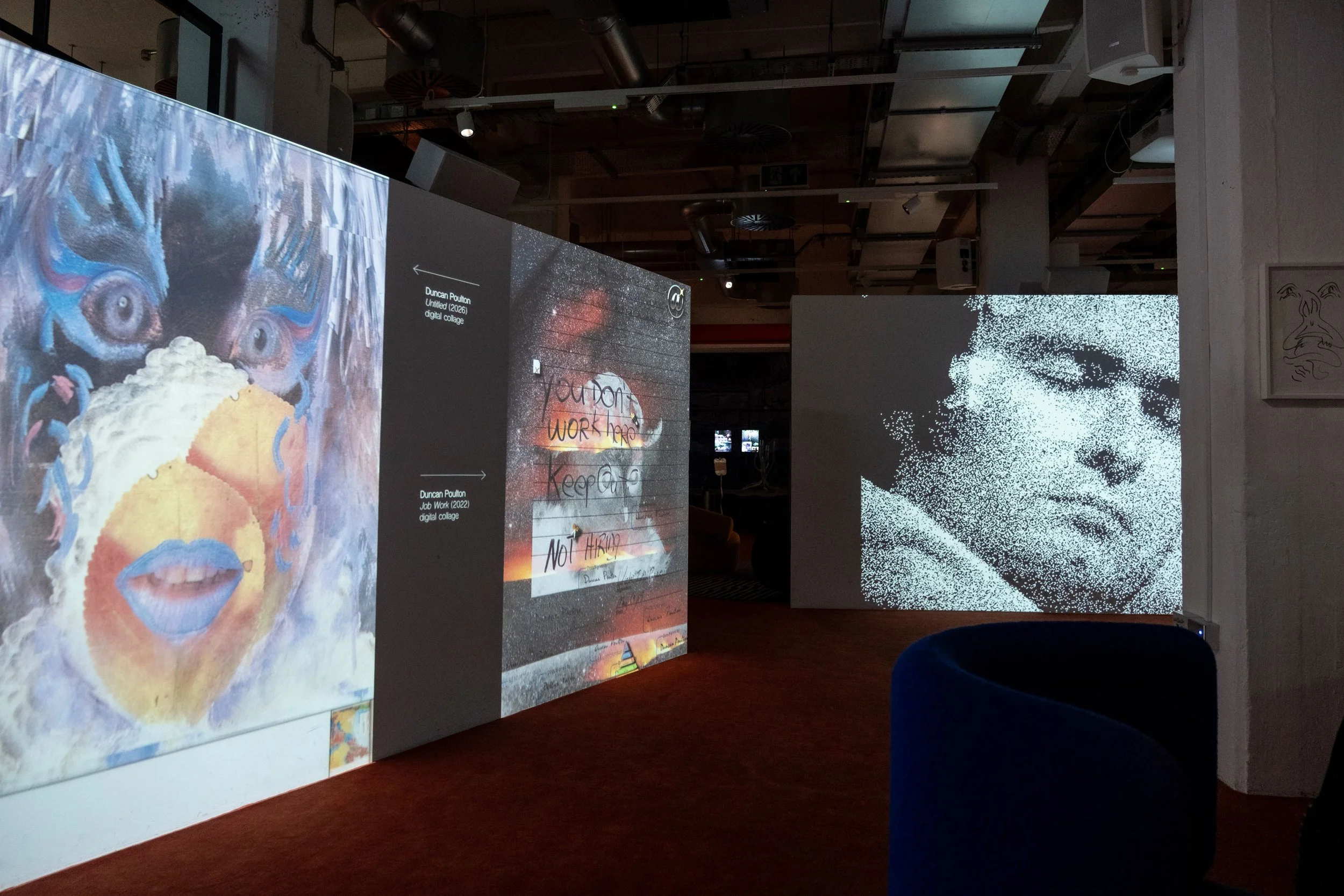

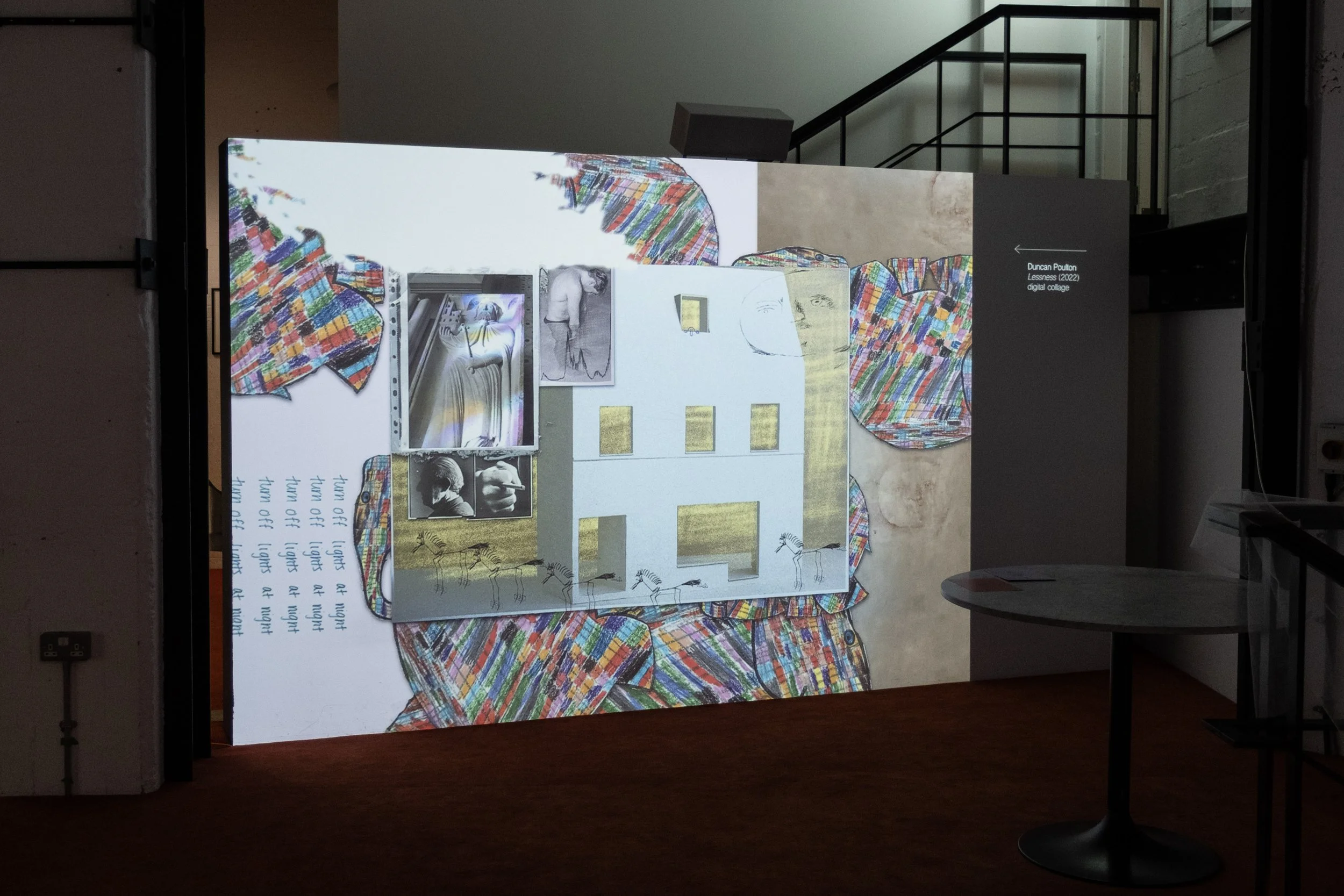

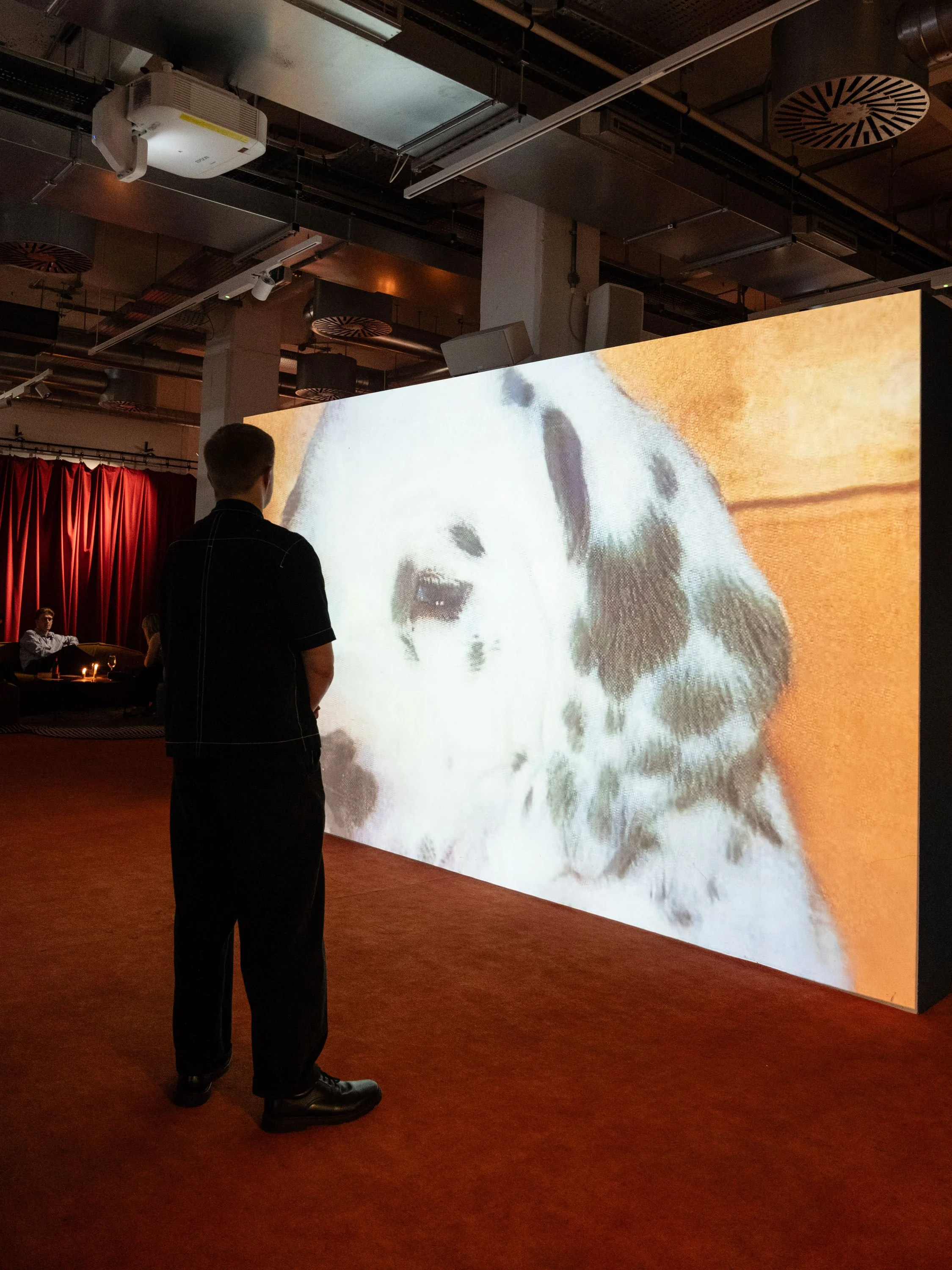
Duncan Poulton: Extreme Present install view at Shoreditch Arts Club, London, 2026. Photo by Chieh-Lin Wu
Cave Dream takes the conceit of a dream analysis. Here I’ve combined a 1970’s documentary about sleep deprivation with found amateur 3D models, video game test footage and infrared photography. We are drawn into the sleeping subject’s mind as he feverishly dreams of a dog, a forest, a crowd amassing in his garden, and an endless warren of caves, whilst his brain and body appears in CT scans and brain activity charts. The whole video is rendered as a densely pixelated black and white bitmap image – the content of the imagination is stripped back to become points of data, or zeros and ones by extension.
In Waste I was interested in cheating my way into making a kind of ‘animation’ using only printed still images. High-resolution scans of printed matter were taken and then zoomed into, panned over and re-filmed off a computer screen interface. This technique creates a re-doubling texture between print, paper, scan and screen, making it feel highly mediated and difficult to place its provenance, a recurring interest in this show and in my work in general. The camera hyperactively darts across closeup abstractions of images: children dressed as robots, workers hunched over their computers, homemade models of buildings and planets, job lot auction listings of toys, labyrinths, and anatomical illustrations of CPR, skeletons and skulls. The final section of the film takes patent diagrams - crude demonstrative drawings for proposed haptic technologies, automata and dolls - which overlap and interfere in a chaotic climax.
Finally, the Shoreditch Arts Club cinema houses an hour-long experimental documentary I made in collaboration with artist Nick Smith in 2023, called Y2K. The video cuts together home video recordings, news clips, TV Ads and self-help books from the years 1999 and 2000. Nick and I are separated by a decade in age so have very different relationships to the Millennium, but were interested to revisit it through the lens of amateur videos from the time. The first half of the film builds up to the existential dread of midnight 1999, and the second half explores the relief and disappointment of its aftermath, ultimately arguing that the non-catastrophe of Y2K may have a direct link to the existential crises of the present.
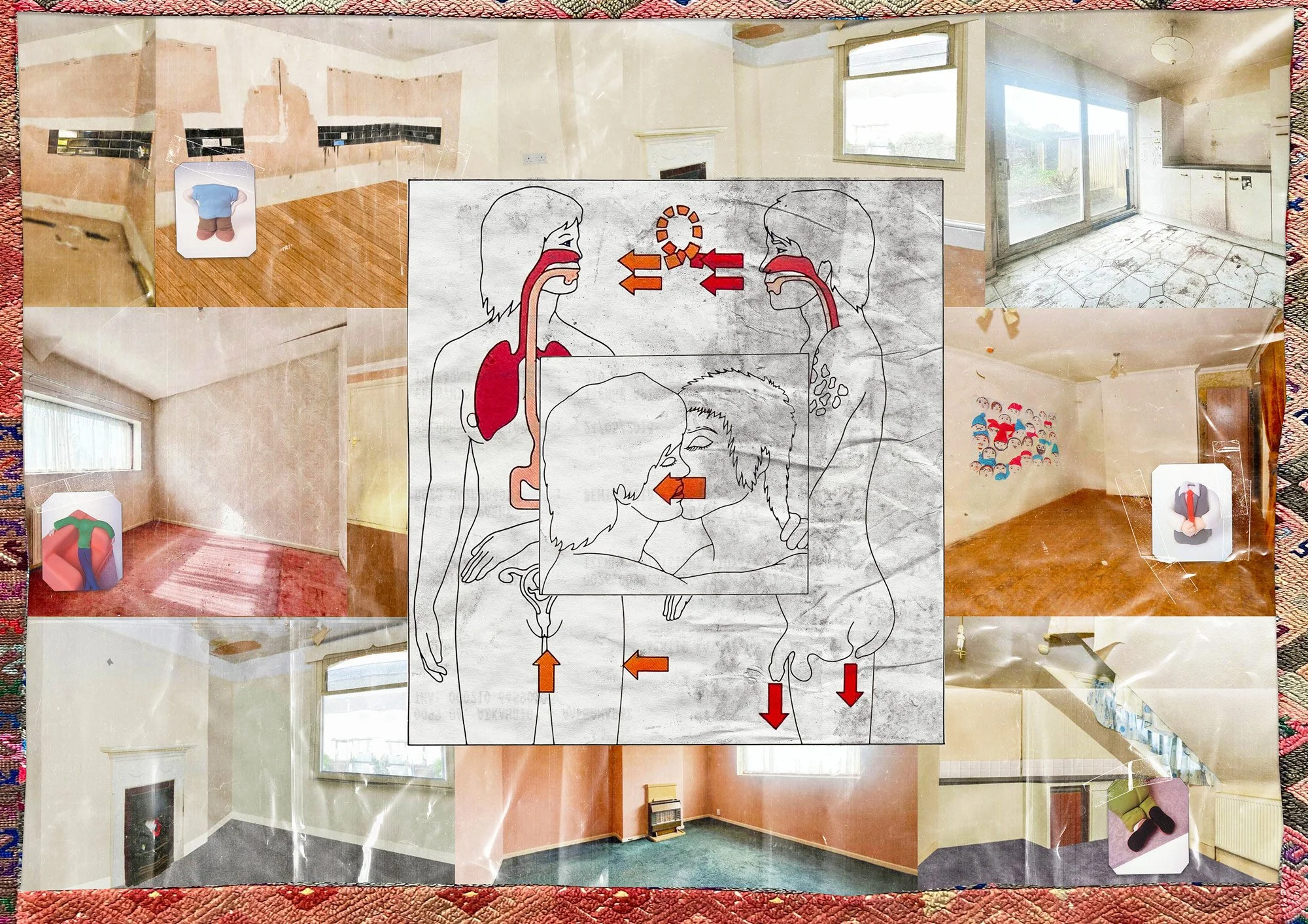
Duncan Poulton, The Kiss (2025), digital collage
One of the qualities you explore in your video works is the nature of ‘found footage’ and collage-making. You mention your obsessive habit of ‘collecting’. Would you be able to tell us what informs this media collection process? What stands out to you in the aesthetic choices that make it into the final cut?
I would describe habitual collecting as the spine of my practice. No matter the medium – video, collage, installation, publication etc – it stems from the bank of material I’m accumulating. Sources are from anywhere and everywhere, I’m following my nose.
Much of the collage material in this show is everyday photo and video uploads crawled from long-dormant or ‘dead’ websites. I roughly redact, erase and distort - the negative space of others’ images is what I’m most drawn to in the most recent work. Having done it for a while, collage for me now is a delicate push-and-pull between busyness and absence. I’m trying to find some version of elegance whilst bottling the visceral sensation of contemporary urban life.
There’s also an autobiographical subtext in many of these works. For instance, The Kiss features found Rightmove listing photos overlaid with sex-ed diagrams and headless male figures made of marzipan (cake decorating how-to-guides have somehow become a staple of my collage book collection). These collages in 2024-5 were made during my partner’s pregnancy. Looking back at these works its interesting to read into them, like a subconscious illustration of imminent parenthood – a feeling that oscillates between happening and not happening to you, a time that is at once mundane and profound.
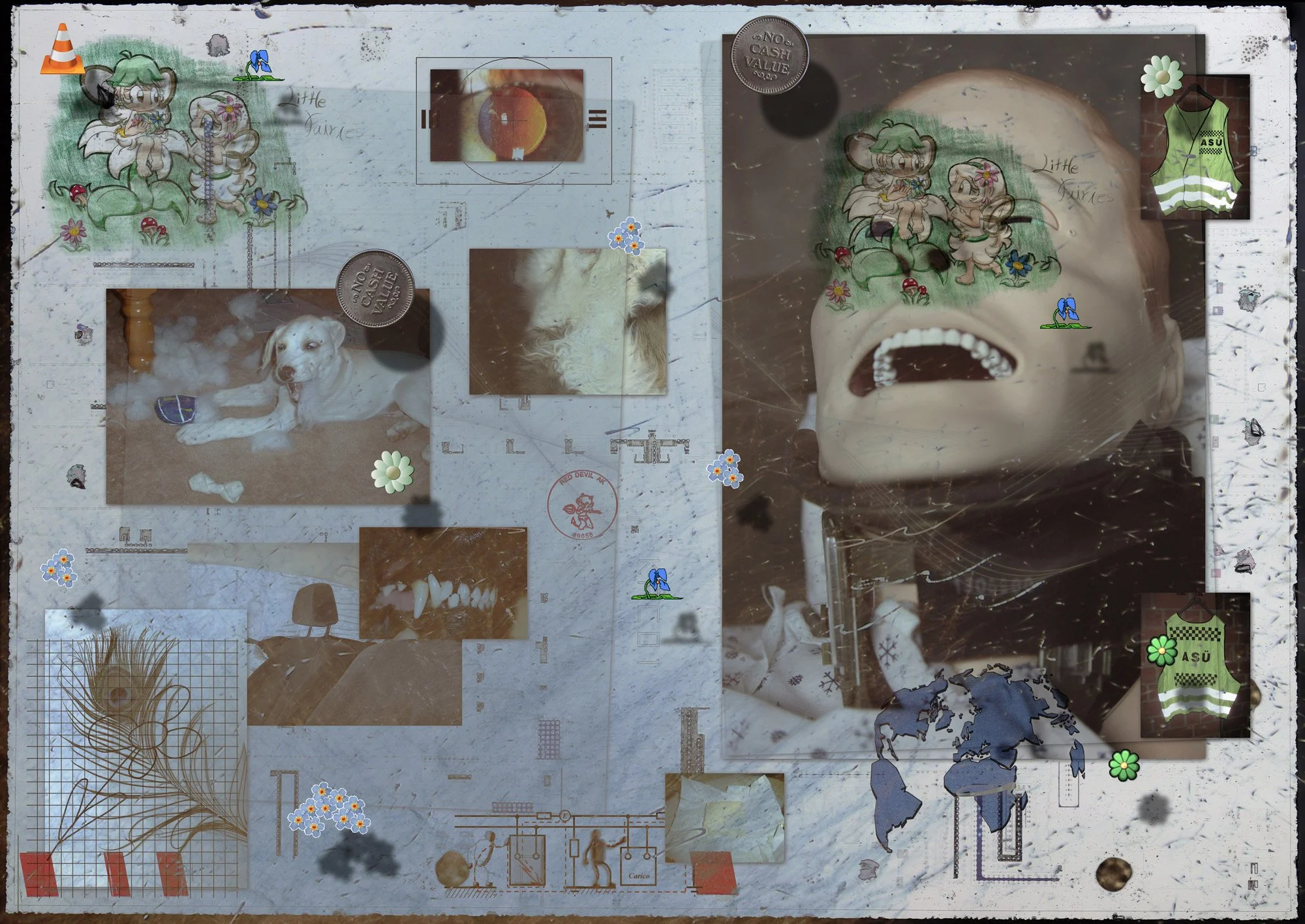
Duncan Poulton, Mortal Song (2022), digital collage
You also collaborate with friends Nick Smith and Sally Beets in two of the films presented. How did this collaboration come about?
Nick and I have known each other since meeting in 2018 as participants in the LUX Critical Forum in London. The chance came up in 2023 to curate a screening programme for TACO! in East London, and the process of trying to put that together organically grew into what became the Y2K film we made together. As we both work with a lot of found material, we had personal archives to draw from and would pass sections of the film edit back and forth in what became a bit of a game of one-ups-manship which fuelled us to refine the edit. Sally works more in the fields of writing, poetry and publishing and so we had more defined roles for this; words and images. We’ve since collaborated on a few books with a similar dynamic.
Finally, which artists do you turn to for inspiration, that you would like to share forward with readers?
Touchstone artists for me are Rauschenberg, Matisse, Magritte and Chagall. Contemporary artists who I come to would be Urs Fischer, Sara Cwynar, Jack Burton, James Richards, Morgan Quaintance, Sarah Sze, Christian Marclay and Oliver Laric (who I actually saw do a great artist talk at Shoreditch Arts Club in 2024). I’m also getting more and more obsessed with animation. Some UK experimental animators I’m into right now are Saul Pankhurst, Edd Carr, Hardeep Pandhal, Jordan Antonowicz-Behnan, Chris Childs and Simon Hamlyn. My favourite show of the year so far has been Sarah Cywnar’s ‘Baby Blue Benzo’ at The Approach.
Extreme Present is on view through the summer at Shoreditch Arts Club.
https://www.duncanpoulton.com/
@duncpoulton
Install view photography by Faith Rubia, Chieh-Lin Wu and Anastasia Belinskaya.
